
 ESE-105_image.png
Foundation Engineering Laboratory is a hands-on, project-based course designed to bridge fundamental engineering theory with real-world physical systems. Through a sequence of twelve progressive laboratory experiments, students explore how mathematical models, physical laws, and logical reasoning directly govern the behavior of mechanical, electrical, and embedded systems.
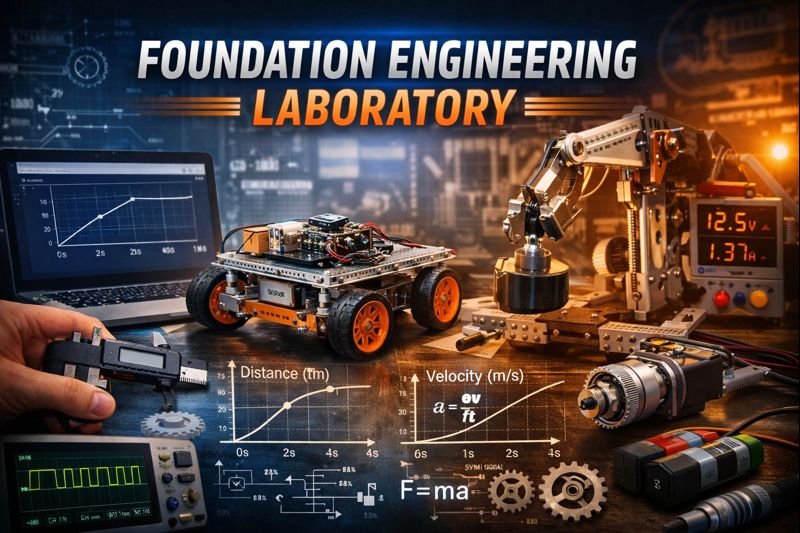
The course begins with experimental investigations of linear and rotational motion, where students collect real sensor data from mobile robots to study distance, velocity, acceleration, and angular quantities. Learners then develop an understanding of functions as physical mappings, using PWM motor control to connect mathematical input–output relationships with observable hardware behavior. Energy, work, torque, and efficiency are explored through practical experiments involving geared DC motors, gravitational loads, and mechanical equilibrium, reinforcing core concepts from physics and engineering mechanics.
As the course progresses, emphasis shifts to logic, decision-making, and safety in embedded systems. Students design sensor-driven control systems using Boolean logic, truth tables, and conditional execution to model real biological behaviors and implement fault-aware electrical safety mechanisms. Mathematical tools such as trigonometry, vectors, and geometry are applied to robot steering, linkages, and motion prediction, strengthening spatial reasoning and analytical skills.
The final labs focus on embedded software architecture, power control, signal conditioning, and system stability, where students learn to write structured, non-blocking code, manage noise in control signals, and validate mathematical models against real hardware behavior. Throughout the course, students practice data analysis, graphical interpretation, model verification, and critical evaluation of experimental error.
By the end of the course, students will be able to design, analyze, and validate integrated electromechanical systems, demonstrating a strong foundation in engineering principles essential for robotics, automation, mechatronics, and applied STEM fields.
- Teacher: Kevon Clarke